Education Agent CRM: Where the 67% Stat Comes From
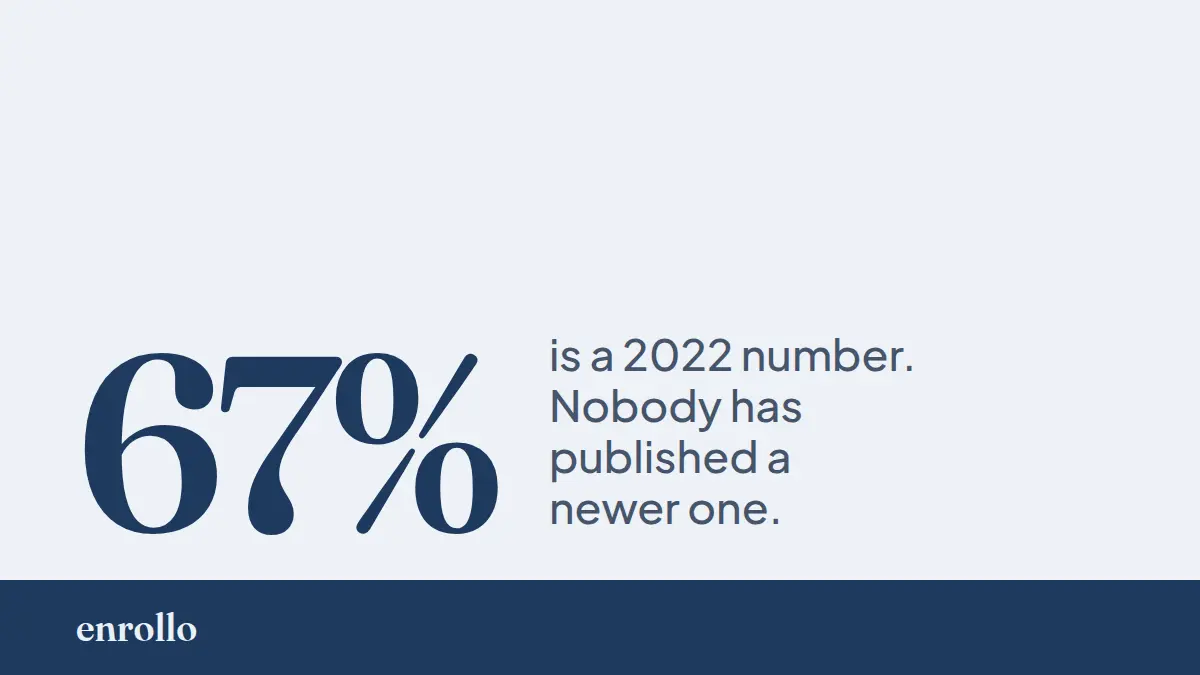
The 67% 'no commission software' figure comes from a 2022 article, and nobody has published a newer one. Where commissions leak in a boutique agency, and how to measure your own gap.
You raised an invoice for £4,000. The university says they already paid. You can't find which student it was for.
If this has happened to you, you're not behind. The most-quoted numbers on agent technology are these: 67% of education agents have no software to manage commission payments, 65% are manually invoicing clients and using Excel for tracking, and 39% have no CRM or software to manage student information (Flywire, reporting ICEF survey data).
Before you use those numbers to justify anything — including buying our software — it is worth knowing how old they are. This guide starts there, then explains where commissions actually leak in a boutique agency, and what an education agent CRM has to track to close the gap.
How old is the 67% figure?
Older than most pages that quote it admit — including, until today, this one.
The page that carries the 67%, 65% and 39% figures is a Flywire article whose structured publication date is 26 September 2022 (its own footer reads "Updated November 21, 2025"). It attributes them to "ICEF’s survey" without naming an edition, a sample size or a year.
The sample most often attached to those percentages belongs to a different, later report. The ICEF Agent Voice 2025 edition gathered responses from 1,225 agents across 113 countries and was conducted between April and September 2025. Read that edition’s published findings and the commission-software figure is not among them: the headline numbers Flywire reports from it are that commission rates average between 11-20%, that 73% of agents have started placing students into new and alternative destinations over the past two years, and that 77% want more training from partner institutions.
A correction. An earlier version of this page said the 67%, 65% and 39% figures came from "the ICEF Agent Voice survey (via Flywire, 2025)" and were measured "across 1,225 surveyed agents in 113 countries". That welded a 2022 statistic to a 2025 sample. We have separated them above rather than restate the join.
What follows for an agency owner is not that the number is wrong. It is that nobody has published a current one, so the honest use of 67% is as a description of where the industry was, not a measurement of where it is — and certainly not a substitute for measuring your own agency. The month-one exercise further down does that in four weeks.
Why are most education agents still tracking commissions on spreadsheets?
Most education agents track commissions on spreadsheets because the spreadsheet is already open, already shared, and already holds last intake’s numbers. It is the default, and defaults do not have to be chosen. Software does.
The pattern is consistent across regions. Most agencies run their commission ledger as a shared spreadsheet, with student records in a second sheet, and university invoices tracked in email threads. None of these connect to each other.
A second correction. This page used to explain the default by price — it said the sector’s CRMs were built for "large agencies with 50+ counsellors and six-figure budgets" and that "annual contracts run into six figures". That was wrong, and the vendors’ own public pages say so. The next section replaces it with what those pages actually publish.
The spreadsheet feels free. The cost shows up later, when the commission gap appears.
What does the commission gap actually look like?
The commission gap is the difference between what an agency is owed and what it actually collects. It typically appears in three stages: Pending to Invoiced (forgotten invoices), Invoiced to Collected (disputed invoices with no audit trail), and Collected to Reconciled (money arrives but you can't match it to a student).
Stage 1: Pending → Invoiced. A student enrolled. The counsellor moved on to the next applicant. Nobody raised the invoice. In a 10-counsellor agency running two intakes a year, a handful of Pending commissions go un-invoiced every cycle. Each one is real money the agency earned but didn't ask for.
Stage 2: Invoiced → Collected. The invoice went out. Months later, the university's finance team disputes it. They say the student withdrew, or that the commission rate was lower, or that another agent claimed the same student. The agency has the invoice, but not the chain of evidence — which intake, which CAS, which conversation. Without that, the dispute usually ends in the university's favour.
Stage 3: Collected → Reconciled. A lump sum arrives in the agency's account. It's labelled "Tuition Fees Agent Payment Q1." The agency knows it covers several students, but the spreadsheet can't tell which ones. So the commission gets recorded against the wrong students, or against no student at all. The next time someone asks "did we get paid for that one?", nobody can answer.
None of these are mistakes. They are what spreadsheets quietly cost every quarter.
What do the other education agent CRMs actually cost?
Less than this page used to claim, and in one case nothing at all to start. Here is what two of the vendors publish on their own pricing pages, checked on 20 September 2026:
| Vendor | What the pricing page publishes | Free entry |
|---|---|---|
| SmartX CRM | EduCa Solo $999/Year, EduCa Reach $1899/Year, EduCa Network $2999/Year (shown as discounted from $1299 / $2299 / $3499). Support stated as "Monday to Friday, 9 AM to 5 PM". | "7-day free trial for all plans. No credit card required" |
| Agentcis | No plan price is shown on the page. It lists what all paid plans include (50GB storage, 2,000 emails in and out per month) and a "Dedicated Setup Service" add-on at $500.00. Organisations with 20+ team members are directed to sales for bulk pricing. | "7-days free trial", plus a free plan for startups under one year old or non-profits, by application |
Two things follow, and neither is the story this page used to tell. First, a published annual figure under $3,000 is not a six-figure contract. Second, a vendor that only routes 20 or more seats to a sales conversation is not built for 50+ counsellors — that threshold tells you where it expects its customers to sit.
We are not quoting a price for every vendor here. We could not read a published figure for Meritto today, so we are not stating one; treat any price you have been shown as the one to confirm in writing before you sign. The prices above are printed as the pages print them, with no currency conversion, because two of these vendors publish figures on more than one page and they do not always agree.
So the mismatch is not price. It is structural. These tools are designed for operations where finance, admissions and counselling are separate teams, and the CRM enforces handoffs between them. In a boutique agency, the same person handles the consultation, raises the CAS request, sends the invoice, and chases the payment. An approval workflow between those steps is a tax, not a feature.
Scope is the other half of it. A tool that covers lead capture, student payments, visa case management and multi-branch reporting is not worse than one that does not — it is answering a different question. If the job you are failing is "which commissions did I never invoice", breadth does not help you, and the breadth is what you are configuring for the first three weeks.
What should an education agent CRM actually track?
An education agent CRM should track the student lifecycle (Lead → Consultation → Applied → Offer → Enrolled), the commission lifecycle (Pending → Invoiced → Collected → Reconciled), and the connection between them. Every commission must be linked to a specific student, intake, and university so disputes can be resolved with evidence rather than memory.
Concretely, this means the CRM should answer five questions at any moment:
Which students are in the Pending stage right now, and which commissions have I not yet invoiced? This catches Stage 1 losses before they age out.
For each invoice raised, which student, intake, university, and CAS reference does it map to? This is the evidence chain for Stage 2 disputes.
When a lump payment arrives, can I split it back to the individual students it covers? This closes Stage 3 reconciliation gaps.
If I work with sub-agents, is each commission split calculated automatically against the agreed share (50/50, 60/40, tiered)? Manual splits are where spreadsheet errors compound.
Across multiple currencies (GBP, USD, AUD, CAD, EUR, INR), can I see real-collected against expected for each intake season? Without this, quarterly forecasts are guesses.
If a CRM cannot answer all five, it is a contact manager with invoicing bolted on, not an education agent CRM. That test applies to us as much as to anyone: enrollo tracks the commission lifecycle per student, and does not take student payments or run visa case management.
How can a boutique agency start closing the commission gap?
Start by mapping every commission stage your current spreadsheet tracks against the five questions above. The gap is your starting point. Then decide whether spreadsheet discipline can close it (rare), or whether the agency needs a CRM built for boutique scale. Either way, every invoice must be traceable to a student.
A practical first month looks like this. Week 1: list every commission your agency raised in the last two intakes. Week 2: mark which ones reached the Collected stage and which are still Pending or disputed. Week 3: identify the pattern — where do most losses sit? Week 4: decide whether discipline alone will fix it, or whether the agency needs different tools.
That exercise is worth more than any sector statistic, and it is the reason the provenance section above matters. A four-year-old percentage cannot tell you whether your agency has an invoicing problem or a reconciliation problem. Four weeks of your own records can, and most boutique founders are surprised by how much sits in Stage 2 and Stage 3.
The boutique commission tracking checklist
Before deciding on any tool, an agency should be able to confirm each of these:
Every invoice raised links to a specific student record
Every student record links to an intake season and a university
Pending commissions are visible without searching email threads
Disputed invoices have an audit trail (CAS, conversations, offer letter version)
Lump payments can be split back to individual students
Multi-currency reconciliation reflects actual exchange at collection date
Sub-agent commission splits calculate automatically against agreed terms
If a spreadsheet can deliver all seven with the discipline currently available in the agency, it is enough. If it cannot, the gap will not fix itself. Just don't let a statistic from 2022 be the thing that decides it — run the four weeks and use your own number.
Written by
Enrollo
Related Articles

EducationLink Alternative for Boutique Education Agents
EducationLink’s own Pricing link opens Edvisor’s site. What the published numbers say for a 1–15 counsellor agency, where EducationLink is ahead of us, and where enrollo differs.
SmartX CRM Alternative for Boutique Education Agents
SmartX CRM publishes its prices, but three pages on its own site quote three different price shapes. An honest comparison for boutique agencies.
EduAgent CRM Alternative for Boutique Education Agents
EduAgent CRM sells the front of the pipeline: enquiry capture, a branded student portal, invoices and appointments. enrollo sells the back of it: offer deadlines and the commission you chase after enrolment. Published prices, honest concessions, and a five-step test you can run in either trial.
Ready to streamline your agency?
Track students, automate commissions, and never miss a deadline. Everything your study abroad agency needs in one place.
No credit card required