What Education Agent CRMs Must Track After the AQF Mandate
UKVI's April 2026 sponsor guidance enshrined the Agent Quality Framework. Here's what boutique education agents now need their CRM to track.
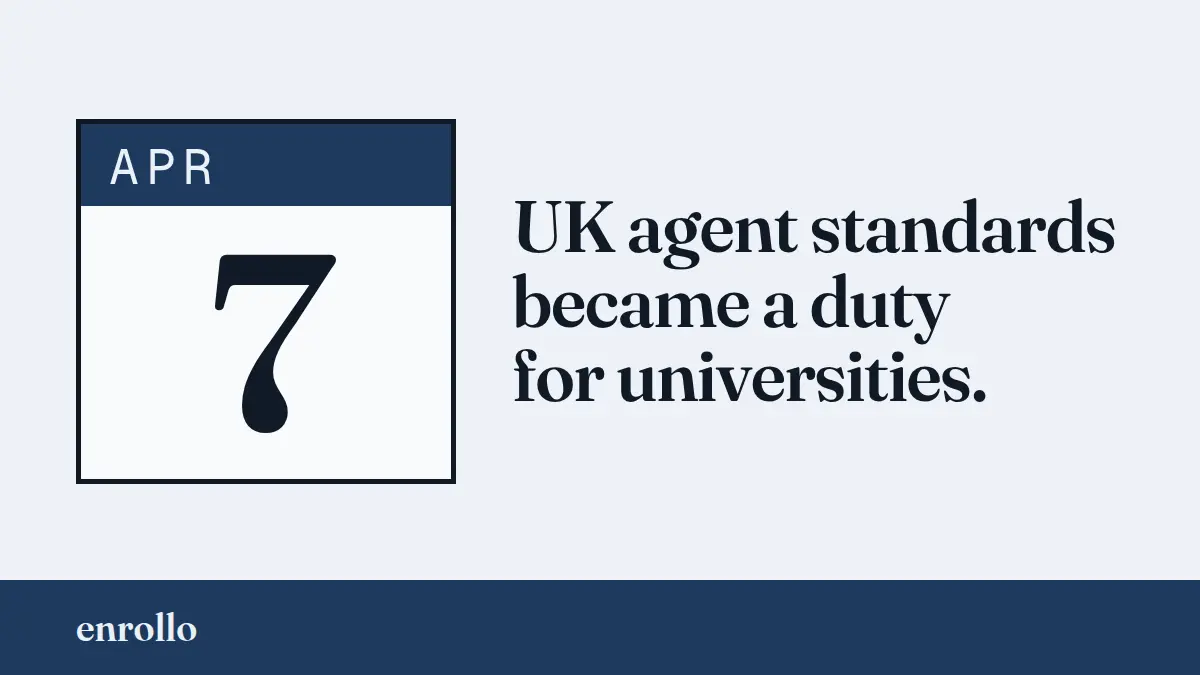
The UK Agent Quality Framework (AQF) used to be voluntary. On 7 April 2026, the UK Home Office updated its Student Sponsor Guidance, and the framework became a documented duty for every UK university that works with education agents. The change does not stop at the university gate. It reshapes what a CRM for education agents needs to capture, every day, for every counsellor and sub-agent on the books.
This guide breaks down what changed, what rolls down to boutique agencies, and what your education agent CRM should be tracking by the end of this intake season.
What changed with the AQF in April 2026?
On 7 April 2026, UKVI (UK Visas and Immigration) published an updated Student Sponsor Guidance that effectively moved the AQF from a voluntary pledge to a documented sponsor duty. According to ICEF Monitor, the guidance requires that all student sponsors using recruitment agents must have committed to adhering to the key principles of the AQF.
The change carries three concrete requirements for sponsors:
List every recruitment agent used to recruit international students when applying for a Student sponsor licence.
Update UKVI within 20 working days of any addition or removal to that list.
Document compliance with the AQF and the National Code of Ethical Practice for UK Education Agents.
The Agent Quality Framework itself was launched in 2022 by the British Council together with BUILA (British Universities' International Liaison Association), UKCISA, and Universities UK International. Until April 2026, institutions could choose whether to engage with it. The 7 April guidance closed that optionality.
Why does this matter for boutique education agents?
The compliance burden does not stop at the university. When sponsors are audited, they look to their agents for proof. Boutique education agencies that work with UK universities now sit inside the same audit chain as enterprise recruitment networks, but without the in-house compliance team that enterprise agencies have.
In practical terms, university partners will start asking for things they used to handle informally:
Copies of British Council UK Agent and Counsellor Training certificates.
The dates each certificate was issued and when each expires.
A list of any sub-agents working under your agreement, with the same training evidence.
Proof that your team has signed the National Code of Ethical Practice.
According to MSM Unify Executive Director Avinav Sharma, writing on LinkedIn after the April update, the digital badge and certificate are no longer nice-to-haves. They are proof points that sponsor partners need to show UKVI. An agency that cannot produce its records quickly risks being removed from a sponsor's agent list, and removal means lost commission pipeline.
What does your education agent CRM need to track now?
Your education agent CRM needs three new types of records per person: British Council certification status, certification expiry date, and adherence to the National Code of Ethical Practice. According to the British Council, certificates issued through the UK Agent and Counsellor Training Course are valid for two years. If your team has five people, that is fifteen audit-relevant fields, not five.
A practical record layout looks like this:
Counsellor records: full name, British Council certificate ID, issue date, expiry date, National Code signature date.
Sub-agent records: the same fields, plus the date you last reviewed their compliance.
Document storage: a link to the actual certificate PDF, retrievable within a minute, not buried in a shared drive folder.
Expiry alerts: a reminder thirty to sixty days before any certificate lapses, surfaced inside the daily workflow rather than an annual review.
The reason a CRM matters more than a spreadsheet here is the 20-working-day clock. Once a counsellor leaves or a sub-agent is added, your sponsor partner needs the updated list inside that window. A spreadsheet that lives on one person's laptop will miss that window the first time someone is out sick.
How do sub-agents change your audit responsibility?
Lead agents are accountable for the conduct of their sub-agents under the National Code of Ethical Practice. According to CATS Global Schools' AQF guidance, lead agencies are accountable for the actions of any sub-agents working under their agreement, and may be asked for full disclosure of their sub-agent network.
That changes the math for any boutique agency that uses a sub-agent layer to reach source markets in South Asia, Southeast Asia, or Africa. Each sub-agent adds:
A separate certificate that needs tracking, with its own expiry.
A separate National Code signature that needs to be on file.
A periodic review that should be documented, not assumed.
A reporting obligation: a new sub-agent is a change to your agent list, which flows up to the university's 20-working-day clock.
Vetting becomes a workflow, not a one-time onboarding step. A sub-agent who joined the network in February with a certificate expiring the following March needs to be flagged before the next intake cycle, not after a university partner asks.
What does audit-ready look like in practice?
Audit-ready means producing every required document in the time it takes to reply to an email. The minimum standard is a single, exportable view that shows every certified counsellor and sub-agent in your agency, with current certificate IDs, expiry dates, National Code signature dates, and last-review dates. The information lives in one place, accessible to whoever picks up the request.
For most boutique agencies, that view does not exist yet. It exists in fragments: certificates in an inbox, sub-agent contracts in a shared drive, expiry dates in someone's head. The April 2026 shift is the prompt to consolidate. The agencies that consolidate first will hold their place on university agent lists. The agencies that wait will find out they were removed when the next intake's commission does not arrive.
The AQF compliance checklist for education agents
Use this as a quick audit of your current setup:
One record per counsellor and per sub-agent inside your CRM for education agents, not spread across email and spreadsheets.
British Council certificate ID and expiry date linked to each record.
National Code of Ethical Practice signature date documented for every person.
Sub-agent review cadence (every six or twelve months) scheduled and recorded as a recurring task.
Export of the full agent list ready in under five minutes for any university partner request.
The AQF is no longer a pledge. It is a duty that flows from UKVI to the sponsor, from the sponsor to you, and from you to every counsellor and sub-agent under your name. The CRM is where that flow either holds together or breaks.
Written by
Enrollo
Team
Related Articles

EducationLink Alternative for Boutique Education Agents
EducationLink’s own Pricing link opens Edvisor’s site. What the published numbers say for a 1–15 counsellor agency, where EducationLink is ahead of us, and where enrollo differs.

SmartX CRM Alternative for Boutique Education Agents
SmartX CRM publishes its prices, but three pages on its own site quote three different price shapes. An honest comparison for boutique agencies.
EduAgent CRM Alternative for Boutique Education Agents
EduAgent CRM sells the front of the pipeline: enquiry capture, a branded student portal, invoices and appointments. enrollo sells the back of it: offer deadlines and the commission you chase after enrolment. Published prices, honest concessions, and a five-step test you can run in either trial.
Ready to streamline your agency?
Track students, automate commissions, and never miss a deadline. Everything your study abroad agency needs in one place.
No credit card required