Australia's onshore transfer commission ban explained
On 31 March 2026, Australian providers stopped paying agent commissions for onshore transfers. What still pays and how boutique agencies adapt.
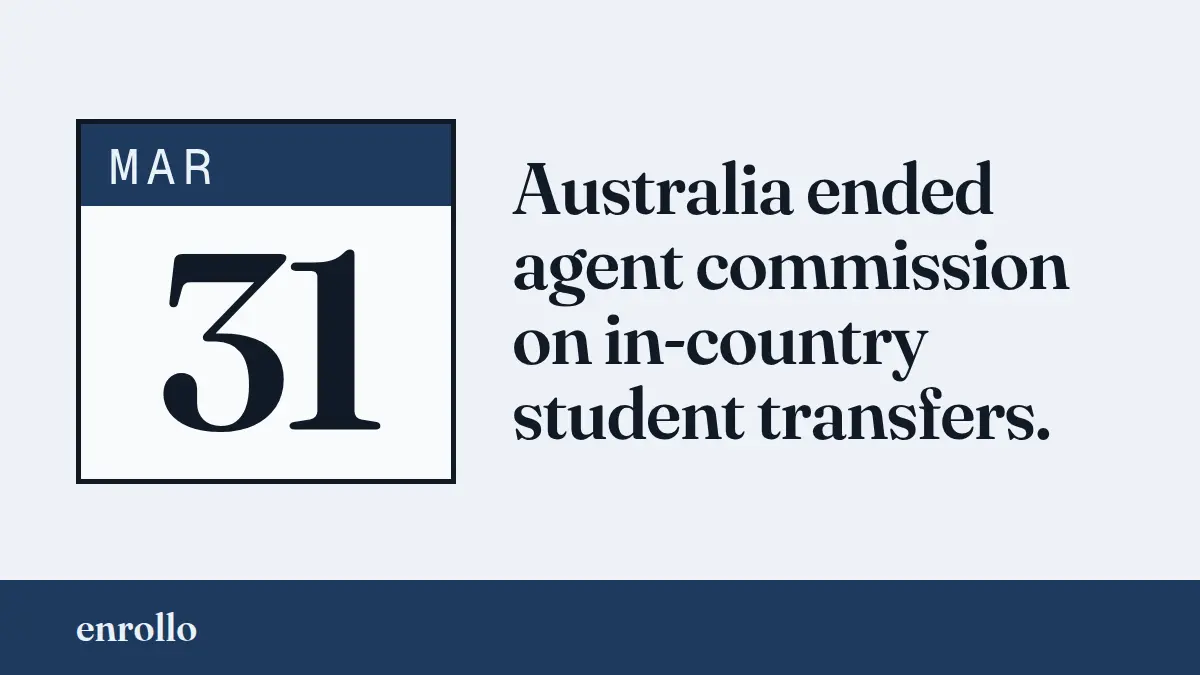
On 31 March 2026, the rule that decides whether your transfer commission legally exists changed. Australian education providers can no longer pay agents for onshore student transfers — and the only carve-out is a single date. For boutique agencies running 1-15 counsellors, the operational question is no longer "did I source the student" but "can my pipeline prove this was an initial enrolment, not a transfer." This guide walks the change as the government wrote it, then translates each line into what a small agency has to actually do before the next intake.
What changed on 31 March 2026?
From 31 March 2026, Australian education providers registered to deliver courses to international students are banned from paying a commission to an agent for onshore student transfers. The change sits in the National Code amendment instrument made under the Education Services for Overseas Students (ESOS) Act, and the government's stated reason is to remove the incentive for unscrupulous agents to facilitate unnecessary or non-genuine transfers.
The ban is not a slowdown or a cap. It is a categorical prohibition on payment when the transfer falls inside the new definition. A school that pays anyway is the entity in breach, and the ban applies regardless of contract wording between the school and the agent. The legal authority — the National Code Amendment Education Agent Commissions Instrument 2026 — is publicly named, so disputes will be resolved against the instrument text rather than commercial intuition.
What counts as an onshore transfer under the new rule?
An onshore transfer is when an international student moves from one provider to another after they have started studying in Australia and before they have finished their principal course. The phrase has three load-bearing parts, and each one needs its own column in your records.
First, the student must already be in Australia and already studying. A change of provider that happens before the student lands is not an onshore transfer for this rule. Second, the student moves between providers. Third, the principal course is not yet complete. If the principal course is complete and the student then enrolls with a new provider, that is a fresh enrolment, not a transfer.
The ban applies whether the student is between courses in a package without completing the principal course, whether their enrolment is cancelled, or whether they voluntarily withdraw. The mechanism the student used to leave the previous provider does not change the result.
Which transfers still pay commission?
Two categories remain payable. First, an international student's initial enrolment to study with an Australian education provider — the first enrolment in the country. Second, progression within a packaged course, where both the provider and the course are already listed on the student's visa Confirmation of Enrolment (CoE).
That second carve-out is narrow. It pays for progression the student's CoE already anticipated. It does not pay for a new provider mid-package, even if the student is technically progressing.
For agencies, the practical line is: anything the student's visa CoE already named, paid; anything that adds a new provider midstream while the principal course is unfinished, not paid.
How does the carve-out work for students accepted before 31 March 2026?
The ban does not apply to students who were accepted for enrolment at their new provider on or before 31 March 2026, even if they start later. This is a transition window pinned to a single calendar date — acceptance date with the new provider, not visa grant date and not commencement date.
For agencies, the operational evidence is the acceptance letter or offer letter date stamped by the new provider. If that document is dated 31 March 2026 or earlier, the transfer remains commission-eligible under the carve-out. If the date is 1 April 2026 or later and the student had not finished the principal course, the commission is gone.
For audit purposes, the acceptance document should sit in the student record alongside the prior CoE. One source of truth, one timestamp, no reconstruction six months later when the school's finance team asks. If you have ever rebuilt an acceptance timeline from email threads, you already know the cost — and the carve-out evidence requirement turns that cost into refused invoices.
What should a 1-15 counsellor boutique agency do now?
The change is a record-keeping problem disguised as a regulatory one. The transfer commissions that used to flow now require evidence of category — initial, packaged progression, or pre-cutoff transfer — and a small agency without that separation built into the pipeline will see invoices rejected without explanation.
The minimum operational change is to tag each enrolment in your system with the category at the moment of acceptance. Initial Australian enrolment, packaged progression already on CoE, transfer accepted on or before 31 March 2026, and transfer accepted after 31 March 2026 are four different commercial events with three different commission outcomes. If your spreadsheet or CRM only has one bucket called "enrolment", that distinction lives in your counsellor's head and exits with them.
The second change is to update the agent agreement template with each Australian partner provider. The wording the school uses to refuse a transfer commission will reference the ESOS instrument; your agreement should reference the same and make the carve-out evidence requirement explicit on your side.
The third change is to read the next 60 days of pipeline differently. Any onshore lead whose previous principal course is not complete, and whose new acceptance lands after 31 March 2026, is no longer a paid student. That does not necessarily mean refusing the work — boutique agencies often choose to support former students for retention reasons — but it should be a conscious decision, not a billing surprise.
Does the ban affect agents based outside Australia?
The ban regulates the Australian provider, not the agent's location. An agent in Mumbai, Lagos, or Seoul cannot be paid an onshore-transfer commission by an Australian registered provider after 31 March 2026, regardless of where the agency is incorporated.
The student's geography is what matters: the student must be in Australia, studying, with the principal course unfinished. The agent's country of registration has no carve-out attached to it. This makes the change a global operational issue for any boutique that places students into Australia from abroad, not only for Australian onshore agencies.
Checklist: where to look in your current process
The following review takes a small agency a few hours and prevents the predictable invoice disputes.
Audit your current pipeline for any transfer accepted by the new provider after 31 March 2026 where the principal course was not complete — those are no longer commission-eligible and should be reclassified before invoicing.
Locate the new-provider acceptance date on every onshore transfer in the last six months; if you cannot point to that single field, your evidence chain is incomplete.
Confirm with each Australian partner whether their commission schedule has been updated and what evidence they will request for carve-out cases.
Separate "initial Australian enrolment" from "transfer" as distinct stages in your tracking; one bucket hides the rule.
Decide a policy on supporting students whose onshore transfer is no longer commission-eligible, and write it once so counsellors do not improvise each case.
Most agencies will find one or two transfers from the last quarter that need reclassifying — better to surface them now than when a school's accounts payable team flags the invoice.
Written by
Enrollo
Team
Related Articles
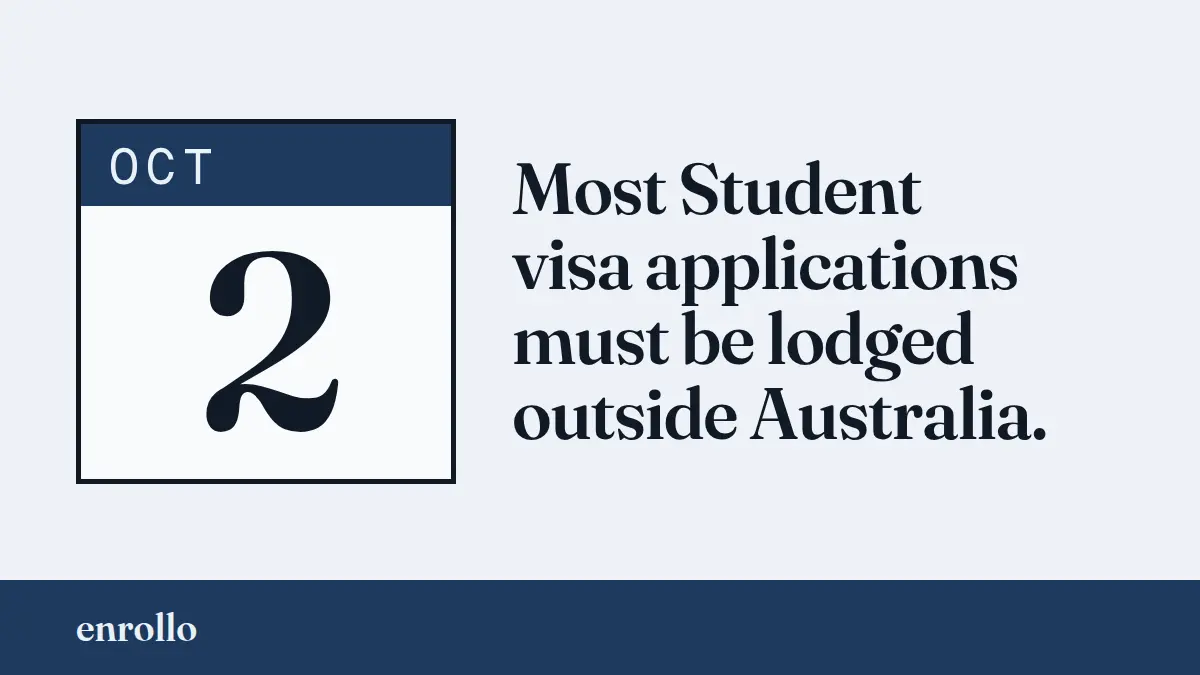
Australia's 2 October 2026 Student Visa Changes: What Education Agents Should Do Differently
From 2 October 2026, most people in Australia on a temporary visa can no longer lodge a Student visa there, and most applicants cannot include a partner or children. The six onshore exemptions, the family exemptions, a triage table and five checks for small agencies.

EducationLink Alternative for Boutique Education Agents
EducationLink’s own Pricing link opens Edvisor’s site. What the published numbers say for a 1–15 counsellor agency, where EducationLink is ahead of us, and where enrollo differs.

SmartX CRM Alternative for Boutique Education Agents
SmartX CRM publishes its prices, but three pages on its own site quote three different price shapes. An honest comparison for boutique agencies.
Ready to streamline your agency?
Track students, automate commissions, and never miss a deadline. Everything your study abroad agency needs in one place.
No credit card required