F-1 Duration of Status 2026: What Education Agents Track
The final rule is published and takes effect 15 September 2026. Which students get a fixed end date, which keep D/S, and the five dates to record.
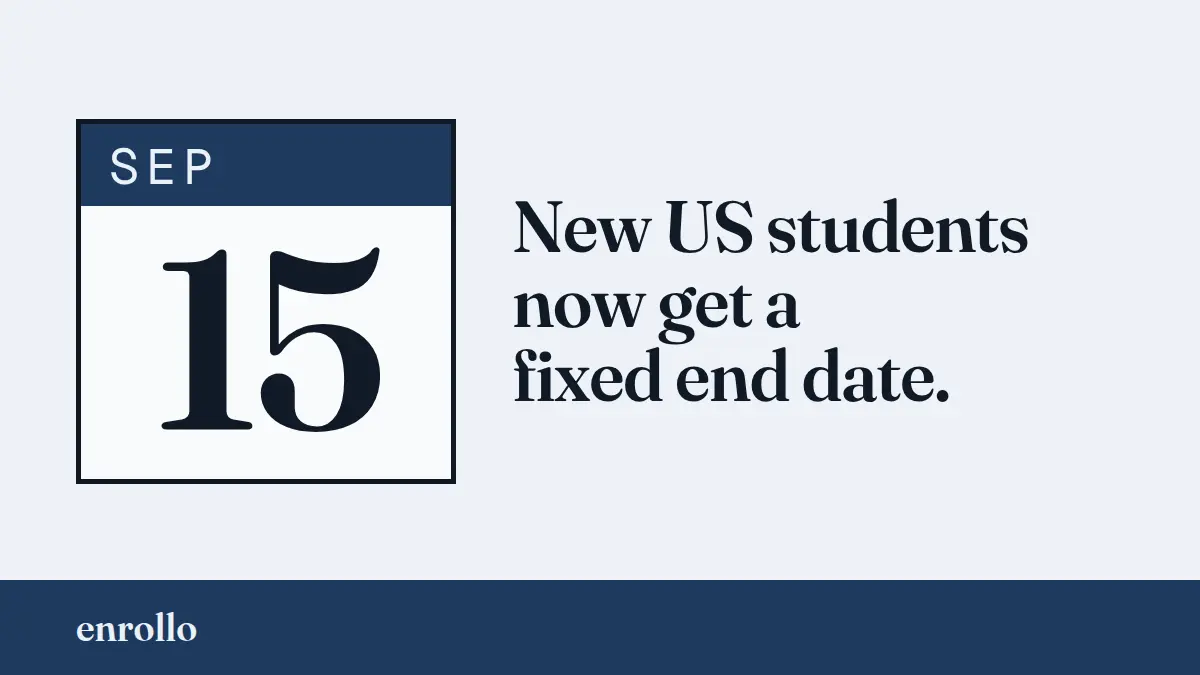
The rule is no longer a proposal. On 17 July 2026 the Department of Homeland Security published a final rule replacing "duration of status" with a fixed period of admission for F, J and I nonimmigrants, and it takes effect on 15 September 2026. For a boutique agency placing students in the United States, the practical change is narrow and concrete: students who arrive after that date carry an end date on their admission record, and the students already there mostly do not. Those are two different tracking jobs, and telling them apart per student is the work this creates for you.
What changed on 17 July 2026?
DHS published the final rule "Establishing a Fixed Time Period of Admission and an Extension of Stay Procedure" (91 FR 44976, docket ICEB-2025-0001). It amends 8 CFR parts 214, 248 and 274a. F and J nonimmigrants are admitted for the length of the program on the Form I-20 or DS-2019, not to exceed four years, instead of for as long as they comply with their status.
The earlier version of this article described the measure as pending, which was accurate when the only published text was the proposed rule of 28 August 2025 (90 FR 42070). That is no longer the position. DHS built a 60-day implementation period into the final rule, which is why publication in July produces an effective date in September.
Note what the rule does not do. It does not give every student four years. The admission period runs to the program length and stops there, so a 12-month master's degree produces a 12-month admission, not a four-year one. Four years is a ceiling, not a grant.
Which of your students get a fixed end date, and which keep D/S?
Split your US list on one date. Students admitted for D/S before 15 September 2026 who are properly maintaining F or J status on that day do not need their Form I-94 corrected to a date certain. Students arriving after the effective date are subject to the full rule and receive a fixed admission period. DHS states plainly that "only participants arriving after the effective date of the rule will be subject to all the provisions of the rule."
The continuing cohort is governed by new 8 CFR 214.1(m)(1). Those students may remain in D/S until the program end date on their I-20 or DS-2019, or four years after the effective date, whichever comes first. DHS has since published a harder outer date in its guidance for schools. A transition student may stay "up to the Program End Date on their Form I-20 or the end of their post-completion OPT or STEM OPT that is valid on the final rule's effective date, not to exceed Nov. 14, 2030" (Study in the States, Quick Facts). An earlier version of this article gave that outer limit as 15 September 2030. That is the four-year point, but it is not the date DHS prints; Yale's Office of International Students and Scholars reads the gap as "four years plus the 60-day grace period". Record the published date, not the arithmetic. A PhD candidate who started in 2025 on a six-year track is the case to look for first, because that student's protection expires before the programme does.
For the September 2026 intake and everything after it, there is a date on the record from day one. That is the group where your file changes shape: an F-1 record that previously held an offer, a deposit, an I-20 issuance date and a visa appointment now also holds an admission end date.
What happens when a transition student travels?
They can come back with a date they did not leave with. This is the part of the rule most likely to catch an agency by surprise, because nothing about the student's file changes until they board a plane. DHS answers it directly: "Yes, current F students can continue to travel; however, as of Sept. 15, 2026, upon returning to the United States, these students may be admitted with a new fixed period of admission" (Study in the States, FAQ).
The same answer names the case that matters most for graduating students: those "who leave the United States before filing for post-completion optional practical training (OPT) or science, technology, engineering and mathematics (STEM) OPT will be readmitted with a fixed period of admission from U.S. Customs and Border Protection (CBP) upon reentry."
So the transition cohort is not a fixed list you can write once in September and file away. A student sits in it until they travel, and then they may not. If you counsel students on a trip home between terms — and most boutique agencies do, because the student asks you first — that conversation now has a compliance side to it.
What is the new departure window after a program ends?
Thirty days, down from sixty. The final rule decreases the period allowed for F-1 nonimmigrants to prepare to depart the United States after completing a course of study or an authorized period of post-completion practical training from 60 to 30 days. A student who ends study or training early must depart, or take action to maintain lawful status, within 30 days of that end date.
Halving that window moves your calendar, not just the student's. Any conversation about a next placement, a progression to a higher level, or a deferral to a later intake now has to start a month earlier than it used to. An agency that habitually opened that conversation in the final weeks after completion was working inside a 60-day cushion that no longer exists.
One more limit sits alongside it. The rule caps language training students at an aggregate 24-month period of stay, including breaks and an annual vacation. Secondary placements have a tighter one: students at public high schools, "which may also include a charter school or other similar school funded by U.S. taxpayers, are limited to an aggregate of no more than 12 months to complete their course of study, including any school breaks and annual vacation" (FAQ). Agencies that route students through an English programme before a degree should count those months as one budget rather than as separate enrolments.
When does a student have to file an extension of stay?
When the programme runs past the admitted period. If a programme is longer than four years, the rule requires the nonimmigrant to apply for an extension of stay, which USCIS adjudicates. The filing is made on Form I-539, Application to Extend/Change Nonimmigrant Status, and DHS provides for collection of biometric information with an extension application as may be required by 8 CFR 103.16.
This is the step with no automatic fallback. Under D/S, a student who took an extra semester stayed in status by continuing to comply. Under a fixed period, the same student needs a filed and adjudicated extension, and adjudication takes time you do not control. Delay in completing a programme by the end date on the Form I-20 — including delay caused by academic probation or suspension — is exactly the circumstance the rule contemplates.
There is one narrow easing worth knowing. The rule provides a short-term reprieve from filing for an extension during the first six months after it takes effect, for those applying for employment authorization for post-completion OPT or STEM OPT. DHS states that reprieve as a filing date rather than a month. Students admitted under duration of status and present in the United States on 15 September 2026 "who timely file for post-completion OPT or STEM OPT by March 18, 2027" do not need to file an extension request (Quick Facts). Yale's international office names the form that has to land by then: a "timely filed Form I-765 for post-completion OPT or a STEM OPT extension" (Yale OISS). That is a transitional allowance tied to work authorization, not a general grace period.
What should a boutique agency record for every US placement?
Five fields, and one of them decides the other four. Work the list in order for each US-bound student, and the answer to the first item tells you which deadlines apply to that file.
Cohort. Did the student enter, or will they enter, before or after 15 September 2026? Before and maintaining status means D/S continues under the transition; after means a date-certain admission.
Programme end date from the Form I-20, recorded as a tracked date the day the I-20 is issued — not as a note in a case comment.
Admission end date — the Admit Until Date on Form I-94, for post-effective-date arrivals: the programme length or four years, whichever is shorter. DHS says a student finds it "on their Form I-94, 'Arrival/Departure Record,' accessible from the Form I-94 website" or on the I-94 attached to a USCIS approval notice (FAQ). It is not printed on the Form I-20, and no school sends it to you — somebody has to ask the student for it. For transition-cohort students, record 14 November 2030 as the outer limit and compare it against the programme end date.
Extension trigger date, set ahead of the admission end date for any student whose programme runs longer than the period they were admitted for. This is the one that needs a filing, so it needs lead time.
Completion date plus 30 days, as the window in which the student must depart or move to another status — and the window in which your next-placement conversation has to already be underway.
Two of these dates did not exist in an F-1 file a year ago. That is the whole operational story of this rule for an agency: a status that carried no expiry now carries one, per student, and nobody at the school is going to send you a reminder about it. The same discipline you already apply to a CAS deadline for UK placements or a provincial attestation letter for Canada now applies to a US admission end date.
Where those dates live matters less than whether they surface before they close. A spreadsheet can hold five dates per student. What it does not do is tell you, on a Tuesday morning, which three students have a date arriving this month. enrollo stores those dates on the student record and surfaces the ones coming due in a daily inbox, so the extension trigger reaches you while there is still time to act on it. Start a free trial and put your US list in one view before the September intake lands.
Key dates at a glance
17 July 2026 — final rule published at 91 FR 44976.
15 September 2026 — effective date; arrivals after this are admitted for a fixed period.
Four years — maximum admission period, or the programme length if shorter.
30 days — post-completion departure preparation window, reduced from 60.
24 months — aggregate cap on language training stays, breaks included.
12 months — aggregate cap for students at public high schools, breaks included.
14 September 2026 — SEVP deploys SEVIS Release 6.89.1, the day before the rule takes effect.
18 March 2027 — last day to timely file for post-completion OPT or STEM OPT and avoid an extension-of-stay application.
14 November 2030 — outer limit DHS publishes for students already in D/S on the effective date.
Rules of this size draw challenges and clarifications after publication. The dates above come from the final rule as published; confirm the current position with the Federal Register text or a qualified adviser before giving date-specific advice on an individual case. For the record you keep on your own side, the fields do not change either way — you want the dates in the file regardless.
Written by
Enrollo
Team
Related Articles
Australia's 2 October 2026 Student Visa Changes: What Education Agents Should Do Differently
From 2 October 2026, most people in Australia on a temporary visa can no longer lodge a Student visa there, and most applicants cannot include a partner or children. The six onshore exemptions, the family exemptions, a triage table and five checks for small agencies.
Education agent CRM pricing: the five line items that decide your first-year cost
The pricing page is one line of a bill that usually has five. A year-one cost worksheet and five questions to send every education agent CRM vendor.
Lead Management for Education Agents (Boutique Agencies)
Where boutique study-abroad agencies lose leads, what lead management means at your size, and how a CRM captures and de-duplicates every inquiry.
Ready to streamline your agency?
Track students, automate commissions, and never miss a deadline. Everything your study abroad agency needs in one place.
No credit card required