Canada Study Permit Changes 2026: PAL Rules for Agents
Canada dropped the PAL requirement for master's and doctoral students at public DLIs on January 1, 2026. What changed and what it means for agents.
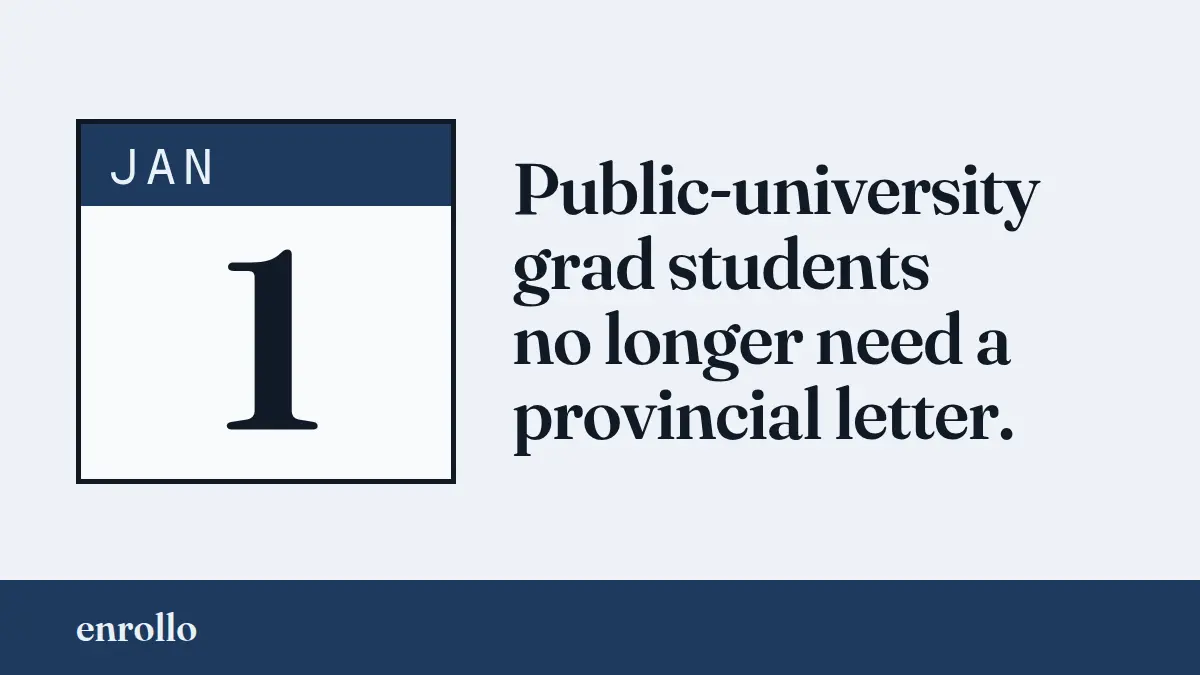
Canada changed two things at once for graduate students in 2026, and both land directly on how agents plan a Canadian pipeline. From January 1, 2026, master's and doctoral students enrolled at a public designated learning institution (DLI) no longer need a Provincial or Territorial Attestation Letter (PAL or TAL) with their study permit application, and those same students are now exempt from the federal study permit cap. According to Immigration, Refugees and Citizenship Canada (IRCC), up to 180,000 study permits will go to applicants who still require a PAL or TAL in 2026. This guide covers what changed, who is exempt, the dates that matter, and what the shift means for an education agency planning Canadian intakes.
What changed for Canada study permits in 2026?
Two things changed. From January 1, 2026, master's and doctoral students enrolled at a public DLI no longer submit a PAL or TAL with their study permit application. Those same students are also exempt from the 2026 federal study permit cap. The cap and the attestation letter still apply to most other applicants.
The PAL (Provincial Attestation Letter) was introduced in 2024 as a control on study permit volume. Each province issued a limited number, and most applicants had to include one for their application to be processed. Removing it for graduate students at public institutions takes a hard documentation gate off the front of the application for that group, and removes a common point where cases stalled.
According to IRCC, the change recognises the contribution master's and doctoral students make to research and the economy, and is meant to keep Canada competitive for advanced talent. The exemption is tied to two facts about the applicant: the level of study (master's or doctoral) and the type of institution (a public DLI). Neither the student's country nor their field decides it.
IRCC set the change out in a program delivery update published on February 6, 2026, recording the new 2026 exception for master's and doctoral degree students enrolled at public DLIs.
Who is exempt from the PAL requirement now?
Master's and doctoral students at a public DLI are exempt as of January 1, 2026. The exemption depends on the level of study and the institution type, not on the student's nationality. Undergraduate and college applicants, and students at many private institutions, still need a PAL or TAL in most cases.
Exempt: master's and doctoral students in a degree-granting graduate programme at a public designated learning institution, starting January 1, 2026.
Also exempt, and easy to miss: preschool, primary school including kindergarten, and secondary school up to grade 12; students at a federally designated military college; exchange students who pay no tuition; Global Affairs Canada scholarship holders; the Francophone Minority Communities Student Pilot; and Quebec vocational programmes leading to a DVS, AVS or STC. The school-age exemption is not new for 2026: it has been on IRCC's list since the programme reforms of February 2024.
Still need a PAL or TAL: most undergraduate and college applicants, and most other applicants from outside Canada who do not fall into an exemption category.
Timing matters: applications submitted before January 1, 2026 still needed a PAL, even for graduate students.
IRCC publishes the full list on its provincial attestation letter page, which also covers applicants already in Canada under a removal order, a temporary resident permit, protected-person status, or an active permanent residence application. Read it in full rather than working from the headline. The graduate exemption got the coverage in January, but the kindergarten-to-grade-12 exemption matters to any agency placing school-age students, and an agent who only followed the master's and doctoral news will not know it is there.
Because the exemption hangs on the institution being public, the DLI type has to be confirmed per case. Two offers at the same study level can land on different sides of the rule if one institution is private. An agent who assumes "graduate equals exempt" will be wrong for any student headed to a private provider.
How do the 2026 cap and processing changes affect graduate applicants?
The 2026 cap no longer counts master's and doctoral students at public institutions. IRCC also opened a 14-day priority processing channel for doctoral applicants applying from outside Canada, as long as the file is complete and biometrics are submitted on time. Accompanying family members can be processed at the same speed when they apply together.
For the applicants who still need a PAL or TAL, IRCC expects to issue up to 180,000 study permits in 2026, with the number distributed to provinces and territories by population. So the cap has not disappeared. It has narrowed to exclude one specific, high-value group while staying in place for everyone else.
The 14-day channel is conditional. It rewards a complete file: correct documents, biometrics submitted on time, and family applications filed together rather than trickling in. An incomplete doctoral file does not get the fast lane, it gets the normal queue. The speed is real, but only for files that are ready on the day they are submitted.
How many application spaces are actually available in 2026?
A total of 309,670 study permit application spaces are available under the 2026 cap. That is how many applications IRCC will accept for processing from PAL and TAL-required students across the calendar year, and it is the number that runs out. The 180,000 figure is what that processing cap is expected to produce in permits actually issued.
The two numbers describe different things, and they fail in different ways. The 309,670 is a queue. Once a province has handed its share to its institutions and those spaces are spoken for, a student with a flawless file still cannot be processed under the cap that year. The 180,000 is the expected outcome once refusals and withdrawals are counted. IRCC set both out in its notice on 2026 provincial and territorial allocations, dated Ottawa, November 25, 2025, which also confirms the exemption for master's and doctoral students at public DLIs.
The wider 2026 picture is up to 408,000 study permits in total: 155,000 to newly arriving international students and 253,000 extensions for students already in Canada. Each province and territory distributes its own allocation to its designated learning institutions, so the limit a student actually meets is rarely the national number. It is whatever their institution has left.
For an agency that has one concrete consequence. Two students with the same profile can get different answers depending on the province, the institution, and how early in the year they applied. If you recruit into the capped stream, the useful thing to record per student is not only the deadline but which allocation the application sits against and when it went in.
Does the change affect deposit and offer timing?
Indirectly, yes. When a documentation gate and a processing delay both shrink, the rest of the timeline tightens around them. A doctoral case that might have taken months for a decision can now resolve in about two weeks, which pulls deposit deadlines, travel, and enrolment confirmation closer together.
For an agency, that compression is the risk. Offer acceptance windows and tuition deposit deadlines do not move just because the permit is faster. A student who is used to a long wait may sit on a deposit deadline that now arrives before they expect it. The agent who tracks each student's offer date, deposit deadline, and permit stage in one place absorbs that change. The agent tracking it across separate spreadsheets is the one who finds out late.
What do the Canada 2026 changes mean for education agents?
For agents, two frictions just came off graduate recruitment to public Canadian universities: there is no PAL wait, and doctoral decisions can land in about two weeks. That changes where the easier wins sit. A documentation step that used to stall master's and doctoral cases is gone, so the bottleneck moves to file completeness and timing.
The practical effect is a shift in the pipeline. Master's and doctoral leads to public DLIs now move faster and carry less paperwork risk than they did in 2025. The work that remains is operational: confirming the DLI is public, lining up a complete file so a doctoral case can use the 14-day channel, and tracking which students fall under the exemption versus the capped stream.
That sorting is easy to get wrong by hand. A graduate applicant at a private institution still needs a PAL. A case submitted in late December 2025 followed the old rule. When the exemption depends on institution type and start date, an agency tracking dozens of students across a season needs a reliable way to see, per student, which rule applies and what is owed when.
What should agents check before the next intake?
Confirm each graduate applicant's DLI is public, confirm the start date falls under the 2026 rules, and make sure doctoral files are complete enough to use the 14-day channel. The exemption is not automatic across all institutions, so the DLI type has to be verified case by case rather than assumed.
Is the institution a public DLI? The exemption depends on it.
Is the student at master's or doctoral level? Undergraduate and college applicants still need a PAL or TAL.
Will the application be submitted on or after January 1, 2026?
For doctoral cases, is the file complete enough for the 14-day channel, with biometrics and family applications ready?
For capped-stream students, is a PAL or TAL secured against the 180,000 allocation?
The headline is simple: Canada made its strongest 2026 move toward graduate students at public universities. The detail is where commission and timing live, and the detail is per student.
Frequently asked questions
When did Canada drop the PAL requirement for graduate students?
From January 1, 2026. Master's and doctoral students at a public DLI no longer submit a PAL or TAL with their study permit application. Applications submitted before that date still needed one.
Are all master's and doctoral students exempt from the PAL?
No. The exemption applies to master's and doctoral students at a public designated learning institution. Students at many private institutions, and undergraduate or college applicants, still need a PAL or TAL.
How fast are doctoral study permits processed in 2026?
According to IRCC, doctoral applicants applying from outside Canada can use a 14-day priority processing channel, provided the file is complete and biometrics are submitted on time. Accompanying family can be processed at the same speed if they apply together.
Do school-age students need a provincial attestation letter?
No. IRCC's published exemption list covers preschool, primary school including kindergarten, and secondary school up to grade 12. An agency placing school-age students does not need a PAL or TAL for them. This exemption is separate from the graduate change that took effect on January 1, 2026, and it predates it: IRCC's February 27, 2024 notice on the International Student Program reforms already listed "primary and secondary school students" under who does not need a provincial attestation letter. If your agency has been chasing a PAL for a grade 11 student, it has been chasing a document that was never required for that cohort.
Does the study permit cap still exist in 2026?
Yes, for most applicants. IRCC expects to issue up to 180,000 study permits to applicants who still require a PAL or TAL in 2026. Master's and doctoral students at public institutions are exempt from that cap.
Written by
Enrollo
Team
Related Articles
Australia's 2 October 2026 Student Visa Changes: What Education Agents Should Do Differently
From 2 October 2026, most people in Australia on a temporary visa can no longer lodge a Student visa there, and most applicants cannot include a partner or children. The six onshore exemptions, the family exemptions, a triage table and five checks for small agencies.

Education agent CRM pricing: the five line items that decide your first-year cost
The pricing page is one line of a bill that usually has five. A year-one cost worksheet and five questions to send every education agent CRM vendor.
Lead Management for Education Agents (Boutique Agencies)
Where boutique study-abroad agencies lose leads, what lead management means at your size, and how a CRM captures and de-duplicates every inquiry.
Ready to streamline your agency?
Track students, automate commissions, and never miss a deadline. Everything your study abroad agency needs in one place.
No credit card required